Cells at Work! is
a manga series written and illustrated by Akane Shimizu. Set in a typical human
body, the series tells the daily lives of blood cells represented by human
beings and what they do during homeostasis and disease. In particular, the
series focuses on a Red Blood Cell codenamed AE3803 and the white blood cell (neutrophil)
U-1146 who frequently meet each other in the series. David Production produced
an anime series which was screened from July to September 2018. In anticipation
of the second season of the anime which is currently in production, I will be
starting a series where I explain the science behind each episode of Cells at Work!
I am passionate in exploring and explaining how the human
body works, particularly in how it defends itself against infection. In fact, I
completed my majors in physiology and immunology in my undergraduate science degree
and I recently completed my PhD in immunology. Hence, I have a good background
of how your body works which helps in understanding what is happening in each
episode and whether each episode is reflective of real-life.
Given my scientific background, this blog series won’t just
touch on the medical side of the episodes. I will also go through the science
of what is happening in each episode to explain how your body works in health
and disease. In addition, I won’t explain every part of the episode. Instead, I
will focus on the main topic of the episode and explain to you some things that
the anime series either simplifies or overlooks. I hope that my blog posts will
complement your experience of the anime series so that you have a fuller
picture of how your body works while understanding what is going on in each
episode.
Tune into the next blog post where I will introduce the characters
of the anime series (i.e., your cells) and what they look like in real life. From
there, look forward to a blog post weekly where I explain the science behind
each episode. See you there!
In the last blog post, I discussed how polls do not account for variations that arise when sample results are extended to the population. I proposed that hypothesis testing and confidence intervals should be used in polls to enable stakeholders and the general public to assess the decisiveness of the results. While hypothesis testing gives a clear-cut answer on whether a poll can conclusively favour one side over the other, confidence intervals reveal the possibilities that might arise from a poll.
In this blog post, I used hypothesis testing and confidence intervals to analyse results from EU referendum polls in 2016. Using these techniques, I drew some interesting insights identifying polls that show a significant result and evaluated the usefulness of telephone polls compared to online ones.
Methodology
I collected a list of online and telephone British polls in 2016 from Wikipedia that surveyed people on how they would respond to the EU referendum question “Should the United Kingdom remain a member of the European Union or leave the European Union?”. I only included polls that had the raw numbers (not proportions) of people that would vote Remain or Leave in the referendum. These were required for calculating the proportion of the sample voting Remain or Leave to a high level of precision (to two decimal places) and to calculate the sample size (the total number of voters participating in the poll) which are used to calculate confidence intervals and p-values (see my previous blog post for more details). I collected weighted values from these polls as they make adjustments to create a nationally-represented sample of the UK.
From these polls, I excluded voters who were undecided or would refuse to vote for two reasons. Firstly, this reduces the number of possibilities to two (Remain or Leave) which enabled me to apply hypothesis testing and confidence intervals to a specific mutually-exclusive side. Secondly, on the day of the referendum, the count excludes anyone who is undecided or refused to vote when deciding whether the UK should Remain or Leave the EU. This can be simulated by excluding the number of voters who are undecided or refuse to vote. I then calculated p-values and confidence intervals of each poll according to the formulae from the last blog post.
Comparing statistical significance via z-values and confidence intervals
In total, 93 telephone and online polls were included in the analysis. Statistical significance can be determined by both the z-value which measures the deviation of the proportion of Leave voters from the null value of 50% (representing equal numbers of Remain and Leave voters) or via confidence intervals which depicts statistical significance by the confidence interval not crossing the 50% proportion threshold. I initially compared z-values and confidence intervals to see whether both techniques can similarly detect statistical significance at the p < 0.05 level.
##
##         No Yes
##   Maybe  4   1
##   No    54   0
##   Yes    0  34
The rows and columns in the table represent statistical significance detected by z-values and confidence intervals respectively. Overall, both techniques can identically delineate statistically significant and non-significant polls. I also included a “maybe” category for z-value hypothesis testing representing polls of borderline statistical significance (i.e., p-values between 0.05 and 0.10). Of these polls, four of them had a non-significant result as derived from confidence intervals.
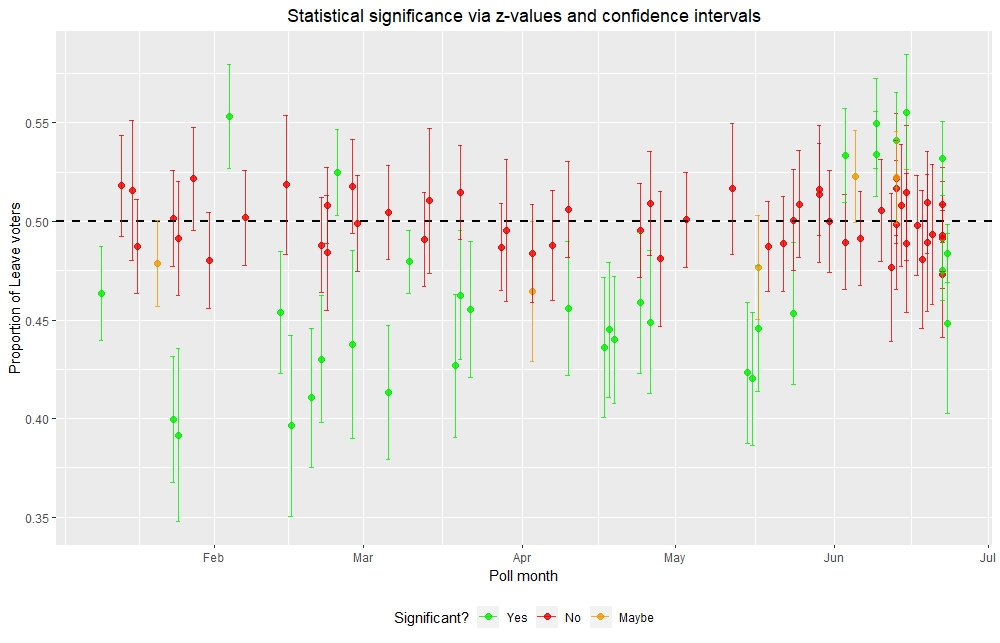
We can visualise the comparison of statistical significance from z-values and confidence intervals:
In general, polls that are statistically significant via z-values have confidence intervals that do not cross over the 50% threshold. In contrast, polls that are not statistically significant via z-values have confidence intervals that cross over the 50% threshold. Polls that are borderline statistically significant (represented by orange) had one end of the confidence interval “touching” or slightly crossing over the 50% threshold. This visualisation shows the ability of statistical techniques to distinguish polls that decisively favour one side from those that show a balance of votes between the two sides.
##
##           No  Yes
##   Maybe 0.04 0.01
##   No    0.58 0.00
##   Yes   0.00 0.37
Most polls (58%) are not statistically significant with the proportion of Leave voters not deviating significantly from the 50% null value. These results suggest that these polls cannot decisively favour Leave over Remain and vice-versa. The remaining polls have a Leave result that is significantly (37%) or borderline (5%) different from the 50% null value.
Overall, these results underline that statistical significance derived from z-values and confidence intervals are equivalent to each other. Therefore, in subsequent analyses, I used statistical significance derived from z-values to investigate polling results further.
How can statistical significance assist in interpretability of polls?
I firstly counted the number of statistically significant and non-significant results from online and telephone polls.
From the graph, most non-statistically significant results come from online polls while most statistically significant results are derived from telephone polls. Identifying an interesting result, I investigated further at the characteristics of online and telephone polls in EU referendum polls.
Surprisingly, all telephone polls that had a statistically significant result favoured Remain as indicated by the lower than 50% proportion of Leave voters. They also had relatively small sample sizes, surveying less than 1,000 people. In contrast, most online polls, which survey more than 1,000 people, do not show a statistically significant result, describing a 50:50 split between Remain and Leave. Of the handful of online polls that are statistically significant, the number of online polls that favoured Leave (indicated by >50% Leave voters) is double that of those favouring Remain.
I also investigated the margins of error between online and telephone polls. Telephone polls had higher margins of error (median = 3.5%) compared to online polls (median = 2.4%) due to the smaller sample sizes. Given that the 2016 EU referendum favoured Leave over Remain, these results suggest that while online polls are more likely to be robust as they survey a larger sample size, telephone polls are more likely to declare a decisive result but are more prone to favour the wrong side. This might be one of the myriad of contributing factors why phone polls are more likely to get the EU referendum result wrong compared to online polls.
How do EU referendum polls track overtime?
I next looked at the polling results overtime and how they are affected by statistical significance, taking into consideration the poll type and sample size.
Most polls are not statistically significant, straddling along the 50% threshold. These polls suggest a 50:50 split between Remain and Leave voters, not favouring one side over the other. Of the polls that showed statistical significance, up until June nearly all of them are telephone polls that favoured Remain (indicated by lower than 50% Leave voters). There were only four online polls that showed statistically significant results with two favouring Remain and the other two favouring Leave. However, from June onwards, nearly all statistically significant results came from online polls. Most of them favoured Leave up until just before the referendum where the last two statistically significant online polls favoured Remain.
These online polls were different from the referendum result which favoured Leave over Remain. This is because there are other sources of error such as voter turnout that are not accounted for in the statistical techniques used. Nevertheless, hypothesis testing is a very powerful tool for limiting polls that show a decisive result from those that do not. This gives us a subset of the data from which insightful conclusions can be made.
Conclusion
Hypothesis testing is very useful for selecting polls that show a significant deviation from a 50:50 split between Remain and Leave voters. Combined with confidence intervals, these statistical techniques have unveiled some interesting results. For instance, while telephone polls are more likely to declare a decisive result, they are also more prone to favour the wrong side as can be seen in the 2016 EU referendum. In contrast, online polls are less likely to declare a decisive result but are more likely to favour the correct side due to surveying more people. It is why nearly all Brexit polls after the 2016 EU referendum are conducted online rathern than by phone.
In summary, the use of hypothesis testing and confidence intervals will serve to better clarify the usefulness of polls and whether they show a decisive result on a particular issue and what range of possibilities are available. Given the explosion of data and information in the modern age, it is more important than ever that people are equipped with the tools to interpret and assess the legitimacy and accuracy of facts. Teaching people how to use and interpret hypothesis tests and confidence intervals will serve them well for not only deciding whether they should care about a poll but also for assessing and debating findings from different sources of information.
The 2016 European Union (EU) referendum produced one of the
biggest surprises of the 21st century. Most polls leading up to the
referendum suggested that the majority of UK would vote Remain in the EU.
However, the referendum produced a different result with 51.9% voters wanting to
Leave the EU. Since then, there have been chaotic scenes on whether and how
Brexit would be enforced. The polling industry has also been under attack with
debate surrounding whether polls are still useful for predicting how the
population would vote on important issues such as Brexit.
The conflict between Remaining and Leaving the EU still rages on in the UK. Source
What the mass media and the general public do not appreciate
is that polls, whose results are taken as the overall view of the population,
only survey one small part of a population that might vote differently from the
sample. This introduces variation in the polling result which might introduce a
situation where it does not favour one side over the other. Hypothesis testing
and confidence intervals can be used to decide whether the public should care
about a polling result and the range of referendum results that are possible
from a poll. If communicated simply to politicians and the public, more informed
decisions can be made on what, if any, one should do to influence people’s
views towards voting Remain or Leave in the EU referendum.
How do opinion polls report variation in results?
Opinion polls are conducted on people drawn randomly from a
population to gauge the population’s views of an issue. It is like tasting a small
sample of a meal such as soup and using our thoughts of the sample to make a
general judgement of the meal. In our case, we use statistics to extend the
results of the sample to make conclusions about a population. The problem of
this method is that people outside the sample may vote differently from those in
it, causing population results to differ from a poll.
Hence, in statistics, it is important to account for the
variation in polling results to capture the true value of the population. This
is encapsulated by the margin of error
which is added or subtracted from the sample value obtained in a poll.
Mathematically, this can be defined as:
Population value =
sample value ± margin
of error (± means
add or subtract)
In the case of an EU referendum poll, the sample value would
be the proportion of the sample that vote Remain or Leave while the margin of error
provides the space to capture the proportion of the population that would vote
Remain or Leave. This margin of error is set to 3% in most polls which is not
reported by mass media. Hence, readers might erroneously assume that the
polling results represent the true proportions of the population voting in a
particular way. Although the margin of error is an essential tool to account
for variations of the population value from a poll, it is insufficient as
readers cannot comprehend the different outcomes that might be generated. This
can be resolved by using confidence intervals.
A better tool for reporting variation in results: confidence intervals!
We can subtract or add the margin of error from the sample value to produce the lower and upper bounds of a population value respectively. Combining these bounds produces confidence intervals, the range of values that we are almost certain captures the true population value. Although they can be produced at varying levels of confidence, they are usually set at 95% confidence to almost guarantee (at 95% confidence) that what we conclude from a poll can be generalised to the whole population. This makes it very useful for thinking about the different outcomes of the EU referendum that might be generated from conducting a poll.
Calculating the confidence interval of a polling result
1. Find the sample value of a poll. In our case, we want to calculate the proportion of the sample that vote Leave. This can be calculated as:
2. Calculate the margin of error (MOE) to measure variation in the poll results. In our case, to calculate the MOE for our 95% confidence interval, we use the formula:
The MOE is influenced by the sample size which describes the total number of people that have voted (Total(voters)) in the poll.
3. Subtract or add the MOE from the sample value to get the lower and upper bounds of the confidence interval respectively.
Lower bound = sample value – margin of error
Upper bound = sample value + margin of error
4. Combine the lower and upper bound values to generate the 95% confidence interval. This describes the range of values that we are 95% sure captures the true population value (in our case, the proportion of the population that vote Leave).
Confidence interval = (lower bound, upper bound)
The basics of hypothesis testing
Although confidence intervals can describe the different
outcomes of the EU referendum, it does not give a clear-cut answer of whether
we should care about a poll. This is where hypothesis testing comes in.
In hypothesis testing, we assess assumptions of a population value against data of a random sample. It is analogous to a criminal trial, where a criminal is presumed innocent until enough evidence is collected to prove guilt. In the same sense, we assume that the null (H0) hypothesis is true until proven otherwise. The null hypothesis proposes that there is no deviation from a set population value in response to some event. This arises when we produce a polling result that would have most likely appeared by chance. Conversely, if we have a polling result that is so rare and unusual that it would not have arisen by chance, then we have enough evidence to reject the null hypothesis and accept the alternative (Ha) hypothesis. The alternative hypothesis describes a deviation of the population value from some set value.
In our case, we want to assess whether a poll can decisively conclude that most of the population would vote Remain or Leave. We write our two hypotheses as follows (prop0,Leave is the proportion of the population that would vote Leave from the null hypothesis):
H0: there is an even split of Remain and Leave voters in the poll. prop0,Leave = 0.5
Ha: the poll decisively favours Remain or Leave. prop0,Leave ≠ 0.5
Should we care about a polling result? Let’s use a hypothesis test to find out!
There are many statistical tests that can be used depending on the kind of data that we are analysing. As we are analysing the proportion of people that vote Remain or Leave in a poll, we convert the proportion to a standardised z-value that can be used to calculate probabilities on a normal z-distribution (better known as a “bell curve”).
If we set prop0,Leave = 0.5 (meaning an even split of Remain and Leave voters in the population), we can simplify the z-value to:
This z-distribution (Z) can be used to calculate the probability (the p-value) that we generate a random result that is just as or more extreme that the polling result given some set value from a null hypothesis. This is represented mathematically as:
And can be calculated using normal
tables, a calculator or a computer. We compare the p-value to an alpha value
which is the threshold that the p-value has to go below to reject the null
hypothesis. Although we can set different alpha-values between 0 and 1, it is
usually set to 0.05 (which describes a 5% chance that we get a random result
that is just as or more extreme than the polling result given some null value).
If the p-value is more than the alpha value
(i.e., p > 0.05), then we have failed to reject the null hypothesis. We
conclude that the poll cannot decide whether most of the population would vote
Remain or Leave in the EU referendum.
If the p-value falls below the alpha value
(i.e., p < 0.05), then we reject the null hypothesis and accept the alternative
hypothesis. We conclude that the poll can decisively favour Remain or Leave in
the EU referendum among the population.
Hypothesis testing is useful for deciding whether the public
and stakeholders should care about a polling result, facilitating informed decisions
on how campaigning needs to be done.
Applying hypothesis testing and confidence intervals to a real-life EU referendum poll
Let’s look at an online poll run from 27th to 29th May 2016 by the polling company ICM. Out of 1753 people, 848 (48.37%) voted Remain and 905 (51.63%) voted Leave. Should we care about the ICM poll?
First, let’s use hypothesis testing to decide whether the
ICM poll is decisive. We declare two hypotheses:
H0: There is an even split of Remain and Leave voters in the population. prop0,Leave = 0.5
Ha: There are more Remain voters in the population than Leave voters. prop0,Leave ≠ 0.5
Since we have propLeave = 0.5163 (converted from percentage to decimal), we calculate the z-value as follows:
And calculate its p-value:
The p-value of 0.1738 exceeds the alpha-value of 0.05, so we
failed to reject the null hypothesis. The ICM poll cannot decisively favour Remain
or Leave, implying an even split of two sides among voters in the population.
How can we visualise the indecisiveness of this poll? We can
use confidence intervals to do this.
First, calculate the margin of error (MOE). The MOE will be
the same regardless of whether the proportions of Remain or Leave voters are
used.
This is within the 3% MOE mentioned in most polls.
We use the MOE to calculate the confidence intervals of
Leave and Remain voters.
Leave confidence interval = 51.63 ± 2.34% = (49.29%, 53.97%). This confidence interval
states that we are 95% sure that the true proportion of the population that
would vote Leave is between 49.29% and 53.97%.
Remain confidence interval = 48.37 ± 2.34% = (46.03%, 50.71%). This confidence interval
states that we are 95% sure that the true proportion of the population that
would vote Remain is between 46.03% and 50.71%.
These confidence intervals appreciate that the proportion of
the population voting Remain or Leave might differ from the polling results. The
real power of confidence intervals; though, comes when we visualise them in a
number line.
The number lines above show the ICM poll results (indicated
by the middle point of the line) along with the Leave and Remain confidence
intervals. Two things can be observed from the number line:
A 50:50 split between Leave and Remain voters is
possible in an EU referendum (indicated by a dashed line) because the
confidence intervals of both the Leave and Remain sides contain the 50%
proportion. This result would not provide a clear indication of which side would
win, something the mass media does not appreciate when hyping up a particular
result.
A referendum involving the population might
produce a different result from a poll. Although the poll had a higher
proportion of Leave than Remain voters in the sample, it is possible that in a
referendum over the population, there might be more Remain than Leave voters. Hence,
the poll cannot conclusively favour one side over the other.
These two points open the possibility that the poll might not
capture the views of the population. This is something the reader overlooks not
only because the mass media excludes the margin of error but because they do
not realise that the polling results may not reflect the views of the whole
population. If the confidence intervals of two groups in a sample overlap each
other, it is possible that the referendum results of a population might be very
different from the polling results of a sample.
Conclusion
How polling results are reported by the mass media today
covers up the dangers of extending results from a sample to infer conclusions about
a population. Even citing the margin of error does not paint a true picture of
the range of possibilities that might arise from a poll. In contrast, hypothesis
testing and confidence intervals can produce a lot of insights of how we
interpret polls. While hypothesis testing can tell us whether we should care
about a polling result, confidence intervals can reveal the variability produced
when polling results are extended to the overall population.
Ideally, the mass media would adopt hypothesis testing and
confidence intervals as tools to correctly interpret polls and to responsibly extend
results to the population. Given the mass media’s interest in hyping up polling
results regardless of whether they are warranted or not, this is most likely
not possible. Hence, independent companies should be set up to analyse polling
results and to provide a truthful interpretation of the polls to the public so
that they can decide whether they should act on a poll or not. Keeping the
polling industry accountable to these statistical measures will ensure the
viability of polls in painting a truthful picture of how the population thinks
on various issues of the country.
Poppin’Party and SILENT SIREN are two all-female Japanese bands that play similar styles of music. Poppin’Party is one of the bands that is part of the BanG Dream! franchise established by Bushiroad. Spanning multiple forms of media, the band consists of anime characters whose voice actresses also perform their own instruments in live shows. SILENT SIREN was established in 2010 by a group of amateur female models. They have released many albums and have also performed in various live shows.
The participants of the “NO GIRL NO CRY” band battle. Left is Poppin’Party and right is SILENT SIREN. Source: https://bandori.fandom.com/wiki/File:NGNC_Main_Visual.jpg
These two bands will perform in the band battle event “NO GIRL NO CRY” in Japan on May 18th and 19th. In celebration of this event, I looked at the lyrics of Poppin’Party’s and SILENT SIREN’s songs to identify the themes and sentiments between the two bands. This was done using a methodology established in my last blog post. Additional analyses were also conducted to glean more insights from the songs of both bands.
Exploratory Data Analysis of lyrics
## # A tibble: 2 x 3
##   band         num_songs num_words
##   <chr>            <int>     <dbl>
## 1 Poppin'Party        30      3255
## 2 Silent Siren        38      3659
SILENT SIREN released many songs over their nearly ten years of existence. Luckily, I was able to find enough English translations of their songs to match the number of English translations of Poppin’Party songs. This enabled comparable text and sentiment analyses to be conducted between the two bands.
Both bands had a word that appeared two to three times more frequently in the lyrics compared to other words. For Poppin’Party, that word was “dream” which appeared two times more frequently than other words. For SILENT SIREN’S, the word “love” appeared three times more frequently than other words. These observations may underline the predominant themes of each band’s songs which will be explained later in the blog post.
Commonality cloud: which words are common across both bands’ lyrics?
A commonality cloud visualises the frequency of words that appear in the lyrics of both bands. The size of each word in a commonality cloud is based on how frequently the word appears in both groups of lyrics. Note that a word that appears very frequently in both groups of songs will be bigger in the commonality cloud than a word that appears frequently in one group of songs but not the other.
According to the commonality cloud, both Poppin’Party’s and SILENT SIREN’s songs have words that were associated with feelings and experiences. In particular, love was a common word found in the lyrics of both bands’ songs. Other words relating to experiences that appeared in both groups of songs included “time”, “world” and “summer”.
Comparison cloud: which words are more frequent in one band’s songs over the other?
In contrast to a commonality cloud, a comparison cloud plots words based on whether the word appears more frequently in the lyrics of a band’s songs compared to the other. A difference is taken between the word frequencies of both groups of lyrics. Following this, the word is plotted to one side of the comparison cloud and the size is varied based on the magnitude of the difference. A comparison cloud allows us to identify words and potential themes that are prevalent in a band’s songs over another group of songs.
From the comparison cloud, “dream” appeared more frequently in Poppin’Party’s songs compared to SILENT SIREN’s songs. Also in Poppin’Party’s side of the comparison cloud are words that are related to experiences and the future such as “song”, “future” and “tomorrow”. The appearance of these words in the comparison cloud indicates that Poppin’Party’s songs tend to touch on achieving goals for the future and creating experiences while doing so.
In contrast, SILENT SIREN’s songs tend to touch on romance. “Love” is a word that appeared frequently in SILENT SIREN’s songs, moreso than Poppin’Party’s songs. In SILENT SIREN’s side are words that are also associated with romance such as “sweet”, “darling” and “kiss”. The appearance of these words in SILENT SIREN’s songs indicates that their songs tend to deal with love and romance and how people react to them.
Bing sentiment analysis of the bands’ songs
I conducted a “bing” sentiment analysis of the songs to measure the proportion of positive and negative words of each band’s lyrics. Overall, Poppin’Party’s songs had a higher proportion of positive-associated words compared to SILENT SIREN’s songs.
Half of the negative- and positive-associated words are similar across Poppin’Party’s and SILENT SIREN’s songs. For Poppin’Party’s songs, most of the negative-associated words are linked to sensations relating to negative emotions such as “throb”, “shake” and “painful”. They also have positive-associated words that describe a person’s internal strengths such as “courage”, “strong” and “gentle”. SILENT SIREN’s songs tend to have negative-associated words linked to loneliness such as “cry”, “lonely” and “ambiguous”. They also have positive-associated words that describe sensations such as “happy”, sparkle” and “flutter”. These words might appear more frequently in SILENT SIREN’s songs due to their focus on romance.
NRC sentiment analysis of the bands’ songs
I conducted an NRC sentiment analysis to measure the proportion of words belonging to specific emotions. The proportion of words in six of the eight emotions are similar between the two bands. However, SILENT SIREN’s songs had a lower proportion of words associated with anticipation and a higher proportion of words belonging to fear compared to Poppin’Party’s songs.
Some of the most frequent words associated with each emotion such as “feeling” and “smile” were similar across both bands. There were some unique words in each band; however, that may represent the overall themes of their songs. For Poppin’Party, “sing” is a word that appears across many emotions, namely anticipation, joy, sadness and trust. These emotions can be found in some of their songs which touch on many themes, particularly the idea of playing together as a band.
In contrast, SILENT SIREN’s songs can be split into two broad areas. The words “sweet” and “kiss” can be found in many positive emotions such as anticipation, joy, surprise and trust. These words relate to the romantic theme of their songs. Another area touched on in SILENT SIREN’s songs could be the feeling of loneliness when losing friends or breaking up. This can be seen in the words “lonely” in anger and disgust, “disappear” and “escape” in fear and “leave” and “cry” in sadness.
Conclusion
Conducting text and sentiment analyses of the songs has uncovered some interesting insights about both bands. Poppin’Party’s songs tend to talk about setting and achieving future goals while creating memories and experiences. Their songs tend to be quite positive but they also touch on a variety of sensations and emotions as evidenced in their songs. On the other hand, SILENT SIREN’s songs tend to talk about romance and the various emotions elicited, both positive (in the case of joy) and negative (in the case of loneliness). It is surprising; then, that the similar music styles of both bands can cover up the different topics touched on by both bands. Based on these results, it will be interesting to see how these two bands will clash when they meet in the band battle this weekend.
Acknowledgements
I would like to acknowledge the following people who have translated the Poppin’Party and SILENT SIREN songs from Japanese to English:
Arislation
BlaZofgold
Eureka
Gessami
Kei
Kikkikokki
Komichi
LuciaHunter
Maki
ManekiKoneko
MijukuNine
Misa
NellieFeathers
Ohyododesu
Starlogakemi
Thaerin
Tsushimayohane
UnBound
Youraim
I may have missed other people who have translated songs for this analysis, but I thank you all the same.
This blog post was written with the intention of describing how I conducted my sentiment analyses so that others can replicate what I did and possibly adapt it to their projects. The analysis was conducted in R using the tidyverse series of packages.
Setting up
I started by loading the following packages I needed to conduct sentiment analysis into R:
tidyverse, a suite of packages that makes it easy to manipulate tibbles (a type of table or dataframe) and generate graphs using the dplyr and ggplot2 packages respectively;
stringi as I needed the stri_isempty() function to remove empty lines;
corpus for the text_tokens() function to stem and complete words while cleaning the lyrics;
qdap and tm for cleaning lyrics and conducting initial text mining analyses;
tidytext to access the “bing” and “nrc” sentiment lexicons I needed to conduct sentiment analyses;
wordcloud2 to visualise word frequencies within Bandori songs; and
broom to convert the test results into a table so that parts of the test results can be easily extracted.
I created an empty tibble “lyricsTbl” containing four columns: “doc_id” for numerically identifying the lyrics; “text” for holding lyric data, “title” for song name and “band” for band name. This empty tibble was used to import lyrics and associated data. Note that the columns were set in this exact layout because when the corpus is created, the tibble splits in half with the last two columns being defined as metadata for the lyrics data from the first two columns.
#Create an empty tibble to import lyrics
lyricsTbl <- tibble(doc_id = numeric(), text = character(), title = character(), band = character())
Function building
I created three functions to make it easier to run all importing and cleaning steps in one go with fewer inputs.
I first built the lyric_import() function to import lyrics into the lyricsTbl tibble. This function takes a string containing the name of the lyrics document (doc) and a number (id) for the doc_id and returns a lyricsTbl tibble containing the doc_id and lyrics data as well as its associated metadata (i.e., song and band names). Note that the lyrics documents have to be set up in a specific layout so that parts of the lyrics document are correctly imported into lyricsTbl:
The first line contains the song and band titles, separated with a “ by ” separator.
The second line contains the URL to the lyrics.
The third line is a credits line, acknowledging the person that has translated the lyrics and the date in which the translated lyrics were first uploaded.
The fourth line onwards contains the lyrics.
#Build a function to import lyrics into lyricsTbl
lyric_import <- function(doc, id) {

  #Import raw lyrics document into R
  document <- readLines(doc)

  #Collect song information and lyrics from the raw lyrics document
  first_line <- document[1]
  title <- str_split(first_line, " by ")[[1]][1]
  band <- str_split(first_line, " by ")[[1]][2]
  lyrics <- document[4:length(document)]

  #Remove empty lines in lyrics
  lyrics <- lyrics[!stri_isempty(lyrics)]

  #Combine lyrics into one line
  line <- str_c(lyrics, collapse = " ")

  #Add lyrics and song information into lyricsTbl table
  lyricsTbl <- add_row(lyricsTbl, doc_id = id, text = line, title = title, band = band)

  #Return the updated lyricsTbl table
  return (lyricsTbl)
}
The second function I built is the corpus_clean() function. This function is designed to run the cleaning steps of each lyrics document so that punctuation and common stopwords (commonly-used words that do not add meaning to text analyses) are removed. This function takes a corpus of lyrics documents and a vector of additional stopwords to remove and returns a corpus where punctuation and stopwords are removed.
#Build a function containing a pipe to clean the corpus of lyrics documents
corpus_clean <- function(corpus, stopword = "") {
  #Define stopwords first to remove common and user-defined stopwords
  stopwords <- c(stopwords("en"), stopword)

  #Build a stemmer dictionary from lexoconista.com
  stem_list <- read_tsv("C:\\D\\2015\\PhD\\data science blog\\bandori lyric analysis\\lemmatization-en.txt")
  names(stem_list) <- c("stem", "term")
  stem_list2 <- new_stemmer(stem_list$term, stem_list$stem)
  stemmer <- function (x) text_tokens(x, stemmer = stem_list2)

  #Replace all mid-dots (present in some lyrics) with an empty space. This function was defined as removePunctuation cannot remove mid-dots
  remove_mid_dot <- function (x) str_replace_all(x, "·", " ")

  #Replace original apostrophies in the lyrics with the alternative apostrophe because retaining original apostrophies prevents replace_contraction from working
  replace_apos <- function(x) str_replace_all(x, "'", "'")

  #Clean corpus through a pipe
  corpus <- corpus %>%
    tm_map(content_transformer(tolower)) %>%
    tm_map(content_transformer(remove_mid_dot)) %>%
    tm_map(content_transformer(replace_apos)) %>%
    tm_map(content_transformer(replace_abbreviation)) %>%
    tm_map(content_transformer(replace_contraction), sent.cap = FALSE) %>%
    tm_map(content_transformer(replace_symbol)) %>%
    tm_map(content_transformer(replace_number)) %>%
    tm_map(content_transformer(stemmer)) %>%
    tm_map(removeWords, stopwords) %>%
    tm_map(removePunctuation) %>%
    tm_map(stripWhitespace)

  return(corpus)
}
Lastly, I built the word_freq() function which generates a word frequency table of each song in tidy format (with each row defining a word-song pair and each column representing a variable). This function takes a corpus of cleaned lyrics documents and returns a tidied tibble containing columns for words, song names and their frequencies.
#Create a function showing frequencies of each word in a song in tidy tibble format
word_freq <- function(corpus) {
  #Generate a Term Document Matrix (TDM) and convert it into a matrix
  tdm <- TermDocumentMatrix(corpus)
  matrix <- as.matrix(tdm)

  #Name columns (i.e., the songs) in the matrix
  colnames(matrix) <- meta(corpus)$title

  #Convert matrix into a tibble and add a column containing the words
  tdm_song <- as_tibble(matrix) %>% mutate(word = rownames(matrix))

  #Swap columns so that word column is moved from the last to the first column
  tdm_song <- tdm_song[, c(ncol(tdm_song), 1:ncol(tdm_song) - 1)]

  #Tidy the table so that all song names are placed in one column and remove any rows with 0 frequency
  tdm_tidy <- tdm_song %>%
    gather(key = "song", value = "freq", -word) %>%
    filter(freq != 0)

  return(tdm_tidy)
}
Writing these three functions made it easier to generate the tables of data that were required to conduct sentiment analyses.
Importing and cleaning lyrics data
English-translated lyrics were copied from the Bandori Wikia (https://bandori.wikia.com/wiki/BanG_Dream!_Wikia) and pasted into separate .txt files in Notepad. These .txt files were then saved into one folder containing all the English-translated lyrics of Bandori original songs. From there, the lyric_import() function was used to import translated lyrics from all bands into lyricsTbl. Each lyrics document was assigned a unique doc_id according to the order in the folder.
#Import all lyrics into lyricsTbl
for (i in 1:length(dir())) {
  lyricsTbl <- lyric_import(dir()[i], i)
}
The lyricsTbl containing the lyrics was converted into a volatile corpus. In the creation of the corpus, the lyricsTbl was split into content (containing the “doc_id” and “text” columns) and metadata (containing “title” and “band” columns) tables. The lyrics were then cleaned with the corpus_clean() function. Note that no stopwords were added to the corpus_clean() function alongside the most common stopwords.
#Create a volatile corpus containing the Bandori lyrics
bandori_corpus <- VCorpus(DataframeSource(lyricsTbl))

#Clean bandori_corpus with corpus_clean() function
bandori_corpus_clean <- corpus_clean(bandori_corpus)
This is because each band had words that are overused in a small number of songs (typically one to two songs) without giving much context. Examples of such words include words that were used consecutively (e.g., “fight”), exclamations (e.g., “cha”) and sound effects (e.g., “nippa”). These words were identified for each band using the term frequency-inverse document frequency (Tf-Idf) which identifies the most frequent words spread over few documents. These words along with the band were stored in a CSV file which was loaded into R as “stopwords.”
A tidied word frequency table containing frequencies of all words for each song (minus common stopwords) was generated with the word_freq() function. From there, two anti-joins were conducted to remove the stopwords: the common stopwords that were not initially removed in the corpus_clean() function (under stop_words) and the band-specific stopwords (contained in stopwords). As the word frequency tibble contained the song names but not the band names, the column containing the band names was also added via an inner_join() function between the word frequency table and the meta table of the corpus.
#Create a tidied word frequency table, removing more common stopwords and band-specific stopwords.
bandori_noStop <- word_freq(bandori_corpus_clean) %>%
                  anti_join(stop_words) %>%
                  inner_join(meta(bandori_corpus), by = c("song" =                         "title")) %>%
                  anti_join(stopwords, by = c("word", "band"))
Exploratory data analysis
I initially generated a table which had counts for the number of songs and words for each band. Song counts were derived from the original lyricsTbl tibble while word counts were obtained from the bandori_noStop tibble. They were then combined into one table so that the number of songs and words were matched to their bands.
#Count the number of songs for each band
band_count <- lyricsTbl %>%
                group_by(band) %>%
                summarise(num_songs = n())

#Count the total number of words for each band
word_count <- bandori_noStop %>%
                group_by(band) %>%
                summarise(num_words = sum(freq))

#Combine the total number of songs and words into one table
(band_summary <- band_count %>%
                  left_join(word_count, by = "band"))
From the word frequency table of Bandori songs, I generated a wordcloud of the 100 most frequently used words using the wordcloud2 package. A colour gradient was used with gray, yellow and red representing increasing word frequencies.
#Include only 100 most frequently used words in Bandori songs
top_100_nostop <- bandori_noStop[, c(1, 3)] %>%
  group_by(word) %>%
  summarise(total = sum(freq)) %>%
  arrange(desc(total)) %>%
  head(100)

#Define colour gradient for wordcloud
cloud_colour3 <- ifelse(top_100_nostop$total > 66, "#E50050",
                        ifelse(top_100_nostop$total >= 40, "#F2B141",
                               "#808080"))

#Generate the wordcloud
wordcloud2(top_100_nostop,
           size = 0.25,
           shape = "star",
           shuffle = FALSE,
           color = cloud_colour3)
“Bing” sentiment analysis of lyrics
Here was the ggplot2 theme that I used in most graphs of this blog post.
#Define a theme to be used across all graphs
bandori_theme <- theme(legend.position = "bottom",
                       plot.title = element_text(hjust = 0.5, size = 15,
                                                 face = "bold"),
                       axis.title = element_text(size = 10, face = "bold"
                                                 ),
                       axis.text.x = element_text(size = 8),
                       legend.text = element_text(size = 10))
To do the “bing” sentiment analysis of the lyrics, I matched the words from the word frequency table with the table of known words and their “bing” sentiments via an inner-join. The resultant table bandori_bing contains words that are identified as “positive” or “negative” under the “bing” sentiment lexicon.
#Match bandori_noStop with the "bing" sentiment lexicon
bandori_bing <- bandori_noStop %>%
                inner_join(get_sentiments("bing"), by = "word")
For each band, I counted the number of words that were either “positive” or “negative” and generated a table with separate “positive” and “negative” count columns. I did further calculations to count the total number of sentiment words (total), the difference between the number of positive and negative words (polarity) and the proportion of positive words (prop_pos).
#Count the total number of positive and negative words from "bing" sentiment lexicon
bandori_bing_total <- bandori_bing %>%
                        group_by(band, sentiment) %>%
                        summarise(count = sum(freq)) %>%
                        spread(sentiment, count) %>%
                        mutate(total = positive + negative,
                               polarity = positive - negative,
                               prop_pos = positive / total)
It is possible that the proportion of positive words might appear to deviate away from the 0.50 value by chance. Hence, to test whether there were significantly more positive than negative words, I conducted a Test of Equal Proportions. From the test, I collected the p-values as well as the 95% lower and higher confidence interval values. Along with the number of songs, these were added to the bandori_bing_total table.
#Define empty numeric vectors to store Equal Proportion test results
p_values <- vector(mode = "numeric")
conf_low <- vector(mode = "numeric")
conf_high <- vector(mode = "numeric")

#Conduct the Equal Proportion test to see whether each band has more positive words than negative words (by comparing it to prop = 0.5)
test_results <- for (i in 1:6) {
  z_test <- binom.test(bandori_bing_total$positive[i],
                       bandori_bing_total$total[i],
                       alternative = "two.sided")
  tidied <- tidy(z_test)
  p_values[i] <- tidied$p.value
  conf_low[i] <- tidied$conf.low
  conf_high[i] <- tidied$conf.high
}

#Add test results onto bandori_bing_total
bandori_bing_total$conf_low <- conf_low
bandori_bing_total$conf_high <- conf_high
bandori_bing_total$p_value <- p_values
bandori_bing_total$num_songs <- band_count$num_songs

#Rearrange bandori_bing_total so that number of songs is next to song names, then round decimals to 3 significant values
bandori_bing_total2 <- bandori_bing_total %>%
                        select(band, num_songs, negative:p_value) %>%
                        mutate(prop_pos = round(prop_pos, 3),
                               conf_low = round(conf_low, 3),
                               conf_high = round(conf_high, 3),
                               p_value = round(p_value, 3))
From the bing sentiment analysis, I also generated a graph visualising the proportion of positive and negative words for each band. Given that there were different word counts among the bands, I normalised the number of positive and negative words as proportions so that they can be compared across bands.
#Graph the proportions of positive and negative words for each band
bandori_bing %>%
  group_by(band, sentiment) %>%
  summarise(count = sum(freq)) %>%
  ggplot(aes(x = band, y = count, fill = factor(sentiment))) +
  geom_col(position = "fill") +
  geom_hline(yintercept = 0.50, colour = "black", linetype = 2) +
  scale_fill_manual(values = c("red", "green")) +
  labs(x = "Band", y = "Proportion", fill = "Sentiment", title = "Proportion of positive/negative words in Bandori songs") +
  bandori_theme
I also counted the number of songs that were positive or negative overall according to bing sentiment analysis. Positive and negative songs were defined as songs where the polarity (the difference between the number of positive and negative words) is more than 2 or less than -2 respectively. Songs whose polarities were between -2 and 2 inclusive were defined as neutral because these differences were too small to conclusively group that song as positive or negative.
#Count the number of positive and negative sentiment words for each song (while keeping the band name)
bandori_bing_songSent <- bandori_bing %>%
                      group_by(band, song, sentiment) %>%
                      summarise(total = sum(freq)) %>%
                      ungroup() %>%
                      spread(sentiment, total)

#Replace NAs in bandori_bing_songSent with 0
bandori_bing_songSent[is.na(bandori_bing_songSent)] <- 0

#Continue grouping songs into different sentiment categories
bandori_bing_sort <- bandori_bing_songSent %>%
                      mutate(polarity = positive - negative,
                             result =
                               case_when(polarity > 2 ~ "positive",
                                        (polarity <= 2) & (polarity >= -2) ~ "neutral",
                                        polarity < -2 ~ "negative")) %>%
                      group_by(band, result) %>%
                      summarise(num_song = n()) %>%
                      spread(result, num_song)

#Replace NAs in bandori_bing_sort with 0
bandori_bing_sort[is.na(bandori_bing_sort)] <- 0
“NRC” sentiment analysis of lyrics
Similar to the “bing” sentiment analysis, I initially matched the words from the word frequency table to the table of known words and their emotions via an inner-join. Then for each band, the number of words under a specific emotion were counted. As positive and negative sentiments were already analysed during the “bing” sentiment analysis, data relating to the two sentiments were excluded for the “NRC” sentiment analysis. The table was then modified so that emotions appear as separate columns.
#Match bandori_noStop with the "nrc" sentiment lexicon
bandori_nrc <- bandori_noStop %>%
  inner_join(get_sentiments("nrc"), by = "word")

#For each band, count the number of words under each emotion and exclude positive and negative sentiments
bandori_nrc_total <- bandori_nrc %>%
  group_by(band, sentiment) %>%
  summarise(count = sum(freq)) %>%
  filter(!sentiment %in% c("positive", "negative"))

#Spread the bandori_nrc_total table so that emotions appear as separate columns
bandori_nrc_spread <- spread(bandori_nrc_total, sentiment, count)
Proportions of words under specific emotions were also calculated so that they can be compared across bands. This was done by generating a proportional or marginal table.
#Convert bandori_nrc_spread into a matrix
bandori_nrc_matrix <- as.matrix(bandori_nrc_spread[, 2:9])
rownames(bandori_nrc_matrix) <- bandori_nrc_spread$band

#Calculate proportions for bandori_nrc_total
bandori_nrc_prop <- round(prop.table(bandori_nrc_matrix, 1), 2)
Following this, I generated a graph visualising the proportion of words that appeared under a specific emotion for each band. Again, the height of the bars were normalised in order to calculate and compare proportions across different bands.
#Define a named vector of colours attached to specific emotions
emotion_colour <- c("red", "green4", "lawngreen", "black", "yellow1", "navy", "purple", "lightskyblue")
names(emotion_colour) <- c("anger", "anticipation", "disgust", "fear", "joy", "sadness", "surprise", "trust")

#For each song, count the number of words belonging to a specific sentiment
bandori_nrc_total %>%
  ggplot(aes(x = band, y = count, fill = sentiment)) +
  geom_col(position = "fill") +
  scale_fill_manual(values = emotion_colour) +
  labs(x = "Band", y = "Proportion", fill = "Emotion", title = "\"NRC\" emotion words in Bandori songs") +
  bandori_theme
Acknowledgements
I would like to acknowledge the following people who have translated the original Bandori songs from Japanese to English:
AERIN
Aletheia
Arislation
Betasaihara
BlaZofgold
bluepenguin
Choocolatiah
Eureka
Hikari
Komichi
Leephysic
Leoutoeisen
LuciaHunter
lunaamatista
MijukuNine
Ohoyododesu
PocketLink
Rolling
Starlogakemi
Thaerin
Tsushimayohane
UnBound
vaniiah
Youraim
I may have missed other people who have translated songs for this analysis. If I have missed you, I would also like to thank you all the same.